



On 20 January 2026, the UK government unveiled what it called a once-in-a-generation overhaul of the water system — a long-awaited regulatory shake-up aimed at preventing incidents like the recent South East Water outages that left tens of thousands without running water in Kent and Sussex. (ITVX)
Under the Water White Paper, water companies will be required to carry out infrastructure “MOTs” — proactive health checks on pipes, pumps and sewage works — and a new single regulator will replace the fragmented system overseen by Ofwat and multiple bodies. (ITVX)
This story has already driven headlines — but it’s also the latest chapter in a much broader political debate about how, and by whom, water services in England and Wales should be run. Below, we break down where the major UK parties stand on water company reform, with rare direct insight from my April 2024 interview with Sir Ed Davey, leader of the Liberal Democrats.
Why Today’s News Matters
The government’s White Paper is a response to widespread criticism that existing regulation failed customers and the environment. By merging regulators and introducing preventive checks long practised in utilities like energy, ministers say services will be more reliable and accountable. (GOV.UK)
However, critics from across the political spectrum — including environmental groups and opposition parties — argue the proposals don’t go far enough on structural reform. (ITVX)
Current Thames Water Live Discharges (20 January)
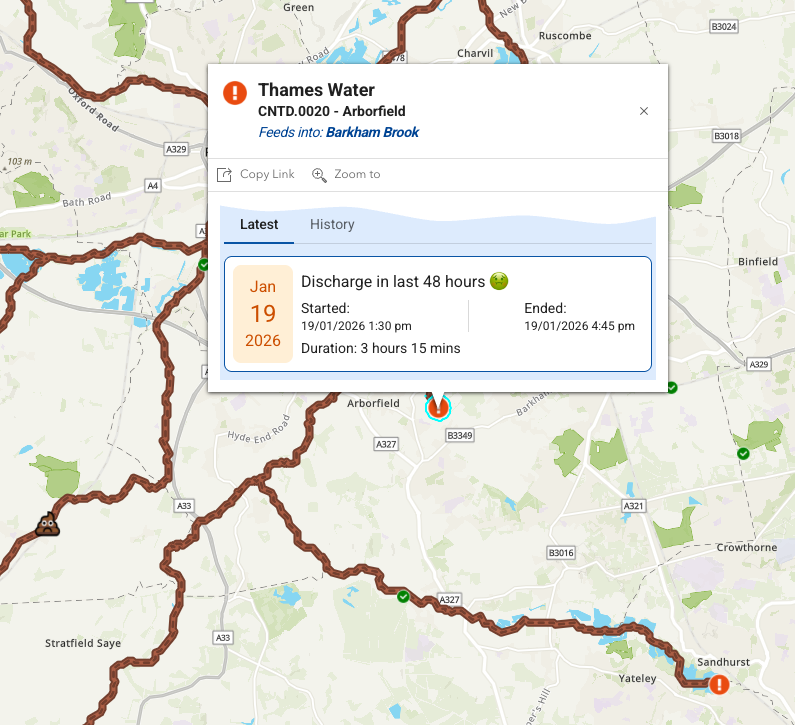
According to the live Sewage Map data (which shows real-time indications of storm overflow activity from water company monitoring): (sewagemap.co.uk)
- CNTD.0020 – Arborfield
Feeds into — Barkham Brook (Berkshire) — current discharge detected. - TEMP.2881 – Sandhurst
Feeds into — River Blackwater — current discharge activity reported. (sewagemap.co.uk) - CNTD.0004 – Burghfield
Feeds into — Clayhill Brook — discharge recorded now. (sewagemap.co.uk)
These are near-real-time indicators that storm overflows are active in these locations, releasing a mixture of rainwater and untreated sewage into nearby watercourses. (Thames Water)
🧠 Why Water Companies Discharge Sewage into Rivers
It might look shocking, but there’s a technical and legal context behind these discharges:
🚰 1. Combined Sewer Systems & Storm Overflows
Most urban sewer networks in England are combined systems — meaning that both household waste (sewage) and rainfall run-off enter the same pipes. When rainfall is light, everything travels to a treatment works where it’s processed properly. But:
- During heavy rain or prolonged wet weather, the volume of water entering the system can rapidly exceed what the sewers and treatment plants can safely carry. (knowledgehub.ice.org.uk)
- To protect homes and streets from back-ups and flooding, relief valves known as storm overflows are built into the system.
- When triggered (usually automatically), these overflows release excess flow directly into rivers, streams, or brooks — mixed with sewage and rainwater. (Ofwat)
This is essentially a safety mechanism to prevent sewage from flooding residential properties — but it also means untreated wastewater enters watercourses when volumes are high. (Thames Water)
📊 2. Regulation & Permits
These discharges are not random:
- Water companies must hold a storm overflow discharge permit from the Environment Agency, which sets out when and how they can operate. (Parliament Research Briefings)
- The use of storm overflows is legally allowed under certain conditions (e.g., heavy rainfall), and is monitored via sensors called Event Duration Monitors (EDMs). (Thames Water)
However, such monitoring only indicates that a discharge may be happening — it doesn’t directly measure pollutants or exact volumes, and it doesn’t confirm safe water quality. (Thames Water)
🌧️ 3. Why They Happen More Often
Several factors contribute to why overflows are activated:
- Older infrastructure: Many sewer networks were not designed for today’s levels of urban development and changing rainfall patterns. (knowledgehub.ice.org.uk)
- Increased rainfall & climate change: More frequent intense storms overload systems more quickly. (knowledgehub.ice.org.uk)
- Under-capacity treatment plants: Some facilities struggle to cope with peak flows, increasing reliance on overflow events. (Thames21)
National data shows that sewage discharges from storm overflows into rivers and coastal waters in England occur hundreds of thousands of times per year — totalling millions of hours of discharge — highlighting the scale of the challenge. (The Guardian)
📌 What This Means for Local Waterways
While these discharges are officially legally permitted in specific circumstances, they have significant environmental and public health implications:
- They introduce untreated sewage into small rivers and brooks, potentially affecting water quality and aquatic life. (Thames Water)
- The impact on water quality can persist for days after a discharge event, which can be critical for swimmers, anglers, and wildlife. (Thames Water)
Liberal Democrats (Ed Davey): Public Interest, Not Privatisation Nor Full Nationalisation
In my April 2024 interview with Sir Ed Davey, he was clear: the privatised model has delivered poor incentives, persistent pollution and underinvestment and needs fundamental reform (you can watch the full interview below).
“We need an industry that is accountable to the public — not divorced from them by shareholders and short-term profit motives.” — Sir Ed Davey, April 2024
The Lib Dem position is to transform water companies into public interest / public benefit companies that are legally required to prioritise environmental quality, consumer protection and long-term infrastructure health over shareholder payouts. (Liberal Democrats)
They also propose replacing Ofwat with a Clean Water Authority with teeth — powers to revoke licences, impose real-time reporting and exclude executives from bonuses where companies pollute. (Liberal Democrats)
How Davey’s view intersects with today’s White Paper:
- He welcomes stronger regulation and accountability, but argues the reforms don’t go far enough in changing corporate incentives.
- Davey warns that a failure-focused regulator is only part of the solution; structural reforms to ownership, governance and financial discipline are also needed.
(This interpretation is drawn from recurring Lib Dem policy themes and his interview commentary.)
📹
🟥 Labour: Tougher Regulation and Enforcement — But Not Nationalisation
The Labour government, now in power, has already passed the Water (Special Measures) Act 2025, giving regulators expanded powers to:
- block executive bonuses when companies pollute,
- impose tougher enforcement,
- install real-time sewage monitors at discharge points. (Wikipedia)
Labour’s manifesto and subsequent actions emphasise placing failing companies under special measures and holding bosses to account — rather than restoring them to shareholders’ control or returning them permanently to public ownership. (The Labour Party)
Prime Minister Keir Starmer’s broader approach has been described as pragmatic reform, balancing investor confidence with stronger regulatory oversight — having shifted away from earlier pledges of full renationalisation. (Wikipedia)
Today’s White Paper reflects this approach: strong enforcement and a new regulator, but no change to ownership models. (GOV.UK)
🟨 Conservatives: Incremental Reform and Investment
Although the Conservatives are no longer in government, their legacy shapes part of the debate. Prior reform efforts — including previous investment commitments and statutory changes — laid ground for today’s combined regulator proposals. (GOV.UK)
Conservatives generally maintain that privatised companies can be made to work with better accountability and robust regulation; they oppose both full nationalisation and rigid state control of assets.
Compared with Labour and the Lib Dems, the Conservative emphasis has been less on structural change and more on market-compatible oversight mechanisms.
🟧 Reform UK: Hybrid Ownership and Focus on National Control
Reform UK’s manifesto proposes an unusual mix of public and private ownership for utilities: 50 % held in public ownership and 50 % by UK pension funds, excluding foreign ownership. (We Own It)
This isn’t full nationalisation, but it rejects the current model where investors can include overseas private equity — seen by Reform as a barrier to long-term investment and public trust.
Reform’s position hasn’t centred on detailed environmental regulation, focusing more on ownership structures and investment incentives.
🟩 Greens: Full Public Ownership
The Green Party explicitly supports bringing water companies into full public ownership as a means of lowering bills, improving infrastructure and tackling sewage pollution. (Wikipedia)
This puts them on the furthest end of the spectrum in terms of structural change.
📊 Comparing the Approaches
What they agree on:
- The status quo has failed customers and the environment.
- Regulation needs to be stronger and more proactive.
(The White Paper’s new regulator and infrastructure MOTs embody this shift.) (GOV.UK)
Where they differ:
| Party | Ownership | Regulation | Structural Reform | Environmental Priorities |
|---|---|---|---|---|
| Lib Dem | Public interest companies | Strong regulatory overhaul | High | Very High |
| Labour | Private but under tougher rules | Strong enforcement | Medium | High |
| Conservative | Privatised with oversight | Continued reform | Low | Medium |
| Reform UK | Hybrid public/pension-fund model | Less detailed | Medium | Medium |
| Greens | Full public ownership | High | Very High | Very High |
(Based on party manifestos and policy analysis.)
📌 What Today’s White Paper Does and Doesn’t Do
✔️ Does:
- Abolish Ofwat and merge regulators into a single body. (GOV.UK)
- Introduce infrastructure MOT-style checks to prevent failures. (GOV.UK)
- Strengthen accountability and performance regimes. (GOV.UK)
❌ Doesn’t:
- Change ownership structures. (GOV.UK)
- Mandate public interest corporate governance.
- Remove investor dividends or fundamentally rewrite how companies are financed.
This is the major point of divergence between Labour/Conservatives and the Liberal Democrat/Gree n approaches.
🧠 Why This Matters
Public trust in water companies has plunged due to repeated sewage incidents and high executive pay. Recent criminal investigations against firms like Thames Water and Anglian Water highlight systemic problems that regulation alone may not fix. (The Guardian)
Meanwhile, public opinion shows broad support for greater public ownership or control of utilities, including water — a theme that continues to influence politicians across the spectrum. (New Statesman)
📌 Final Take
Today’s regulatory shake-up may be a significant milestone — but it’s not the end of the debate. The UK water sector crisis sits at the intersection of politics, public policy and environmental stewardship. How these reforms translate into real change will depend on which ideas carry the day in Westminster and beyond.









Berkshire smells like sewerage farm