

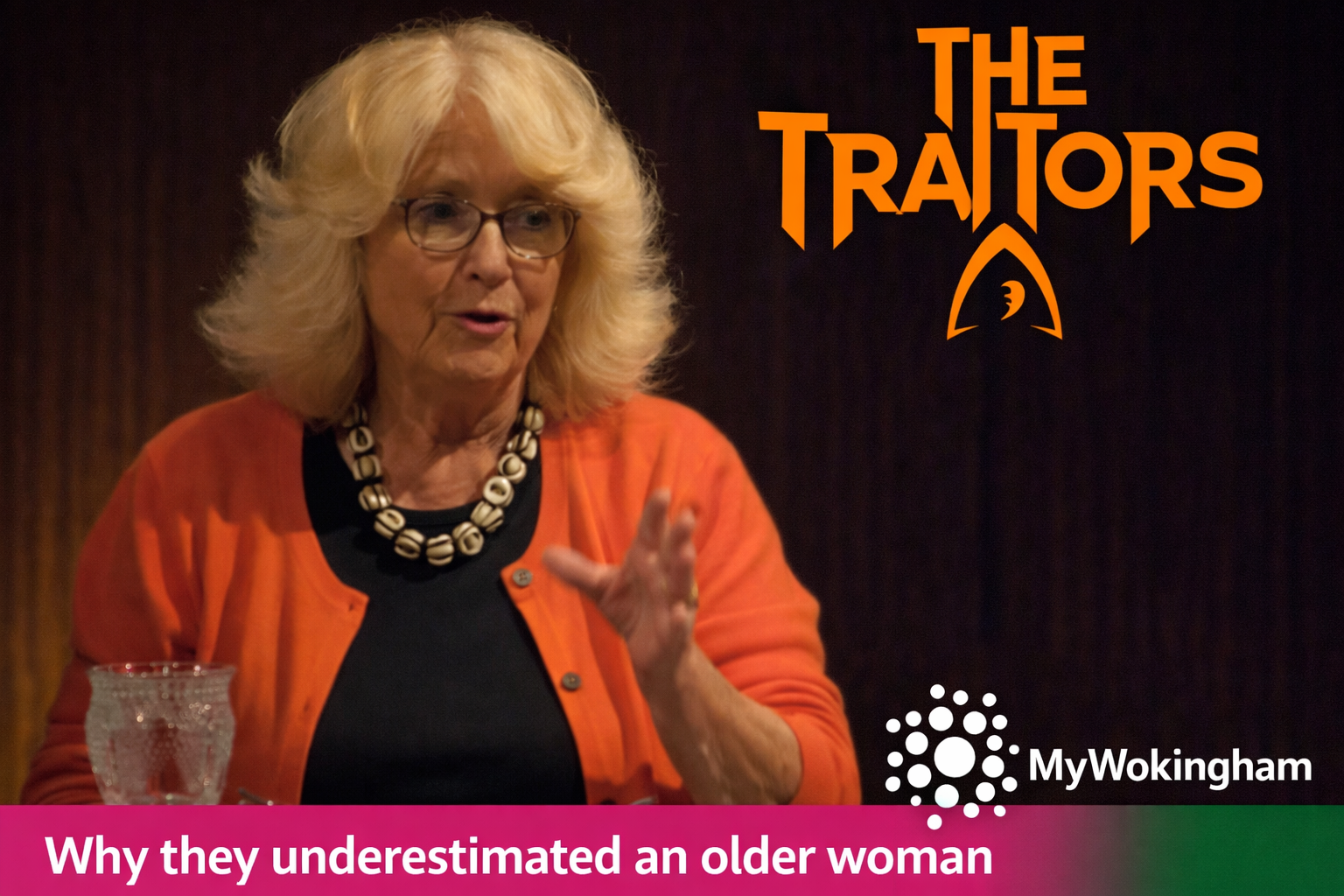
When Fiona first appeared on The Traitors, few viewers saw her as a threat.
At 62, softly spoken and warm, she fitted neatly into a familiar television stereotype: the “nice older woman” who might offer comfort, not confrontation. But within days, that assumption collapsed spectacularly. Fiona didn’t just survive The Traitors — she weaponised being underestimated, turning age, perception and psychology into one of the most talked-about strategic performances the show has ever seen.
And according to psychologists, what Fiona pulled off isn’t just good television. It’s science.
The Twist That Changed Everything
This season of The Traitors introduced a game-changing twist: the Secret Traitor — a saboteur hidden not only from the Faithfuls, but from the other Traitors themselves.
When Fiona was revealed as that Secret Traitor, social media erupted. Viewers who had dismissed her early on were stunned. Contestants who had trusted her openly were left scrambling. Critics called it one of the most audacious casting decisions the show has ever made.
But the real shock wasn’t just the twist — it was how believable Fiona’s cover had been.
The “Invisibility Advantage” of Older Women
In a widely shared Independent feature, writers described Fiona as benefiting from what sociologists sometimes call the “invisibility cloak” — the way older women are routinely underestimated, overlooked, or seen as non-threatening in public life.
On The Traitors, that invisibility became a strategic superpower.
Players spoke freely around Fiona. They underestimated her influence. They didn’t track her movements as closely as younger or louder contestants. In a game built entirely on perception and suspicion, that bias created the perfect blind spot.
Psychologists link this to implicit bias — unconscious assumptions we make about people based on age, gender or appearance. When someone doesn’t fit our mental image of a “strategic threat,” we stop scrutinising them properly.
Fiona didn’t fight that bias. She used it.
The Science of Why Experience Beats Flash
While ageing is often framed as cognitive decline, research tells a more nuanced story — especially when it comes to social intelligence.
Studies in psychology and behavioural science show that while raw processing speed may peak earlier in life, skills tied to emotional intelligence, intuition, pattern recognition and social reasoning often strengthen with age.
In games like The Traitors, success depends less on quick maths and more on:
- Reading people
- Spotting inconsistencies
- Managing impressions
- Knowing when to speak — and when to stay silent
These are skills refined through decades of real-world interaction.
Fiona’s background as a local government officer — a role that requires negotiation, diplomacy and trust-building — likely sharpened exactly the abilities the game rewards.
Emotional Regulation: A Hidden Competitive Edge
Another well-documented psychological shift with age is improved emotional regulation.
Older adults, on average, show greater ability to manage stress, suppress impulsive reactions and stay calm during conflict. In The Traitors, where paranoia runs high and emotional slip-ups can be fatal, that calmness is invaluable.
While younger contestants often reacted defensively or emotionally at the round table, Fiona remained composed — even when suspicion brushed close.
That steadiness made her seem sincere. And sincerity, in a game built on deception, is priceless.
Why Fiona’s Big Move Worked
One of the most explosive moments of the series came when Fiona publicly challenged fellow Traitor Rachel, triggering a dramatic confrontation that had viewers glued to their screens.
It looked risky — even reckless.
But psychologically, it was clever.
By breaking expectations of passivity often placed on older women, Fiona reframed herself at exactly the right moment. After weeks of blending in, the sudden assertiveness caused confusion rather than suspicion. Players questioned each other instead of her.
It’s a classic strategy in behavioural game theory: change your pattern when your opponents least expect it.
Stereotypes That Backfire
Reality TV has long favoured youth, loudness and extroversion. Older women are often cast as background characters, emotional anchors or early exits.
Fiona’s performance flips that script — and exposes how damaging those stereotypes can be.
By assuming she lacked ambition or cunning, other players handed her freedom of movement. By assuming her age meant predictability, they missed her strategic pivots.
As one critic put it: Fiona didn’t just play the game — she played the players’ assumptions about her.
Why Viewers Can’t Stop Talking About Her
Fiona’s story has resonated far beyond the castle walls.
On social media, viewers — especially women — have celebrated her as proof that life experience still matters, that sharpness doesn’t disappear with age, and that older women don’t need reinvention to remain formidable.
Clips of Fiona’s calm conversations and decisive moments have gone viral precisely because they contradict what audiences expect to see.
She’s not loud. She’s not flashy. She’s not chaotic.
She’s strategic — and that’s why it worked.
More Than Reality TV
What Fiona achieved on The Traitors taps into a much wider cultural conversation.
In workplaces, politics and media, older women are routinely overlooked — even as research consistently shows that experience-driven judgement, emotional intelligence and long-term thinking are crucial leadership traits.
Fiona’s rise isn’t just entertainment. It’s a reminder that competence doesn’t always announce itself loudly — sometimes it sits quietly, waiting for everyone else to underestimate it.
The Final Verdict
Fiona didn’t hijack The Traitors by accident.
She did it by:
- Exploiting unconscious bias
- Leveraging emotional intelligence
- Staying calm under pressure
- Understanding people better than they understood her
The science backs it up. The audience felt it. And reality TV may never look at older women the same way again.
If The Traitors has taught viewers anything this season, it’s this:
Never underestimate the older woman in the room — she’s probably already three moves ahead.
Frequently Asked Questions About The Traitors UK
1. What is The Traitors UK?
The Traitors is a psychological reality competition series on BBC One, where contestants are divided into two groups: the hidden Traitors and the unsuspecting Faithfuls. The Traitors work secretly to eliminate Faithfuls from the game, while the Faithfuls must try to identify and banish the Traitors through discussion and voting rounds. (
👉 In the current Series 4, the show introduced a “Secret Traitor” twist — a role concealed even from the other Traitors — adding a dramatic layer of deception and strategy.
2. How does the game work?
Each day, contestants compete in tasks to add money to a shared prize pot. At night, the Traitors secretly decide on one Faithful to “murder,” removing them from the game. The next morning, Faithfuls discover only that someone didn’t show up for breakfast — they don’t know who was eliminated. Every day ends in a Banishment Ceremony, where players discuss and then vote on someone they suspect is a Traitor.
If enough Faithfuls banish all Traitors, the remaining players share the prize fund. But if even one Traitor survives to the end, the Traitors take all the money. (Yahoo News UK)
3. What is the “Secret Traitor” twist in Series 4?
In Series 4, the show added a new layer of drama by introducing a Secret Traitor whose identity wasn’t known to the other Traitors or the audience at first. This person selects potential elimination targets that the Traitors must then choose from each night.
This twist is the season’s biggest shift in format and added strategic complexity — and it’s the twist that Fiona used to her advantage before her eventual unmasking. (Wikipedia)
4. Who hosts The Traitors UK?
The show is hosted by Claudia Winkleman, who moderates the rounds, announces eliminations, and guides contestants through strategic moments like the Round Table discussions.
5. How many contestants are there?
In the 2026 Series 4, 22 contestants entered the Scottish Highland setting, including a mix of public personalities, careers, and backgrounds. Their identities and alliances start unknown to one another, which fuels strategic uncertainty and social tension. (Wikipedia)
6. Do the contestants know who the Traitors are?
No — only the Traitors know each other at the start (unless there’s a Secret Traitor). Faithfuls must work collectively to deduce who is misleading them through observation, discussion, and intuition.
7. What happens at the end of the game?
In earlier seasons, when a Traitor was eliminated, they revealed their affiliation. That changed in recent seasons — including the latest — so banished players do not reveal whether they were Traitors or Faithful, making the endgame even more uncertain. (Yahoo News UK)
Once players agree unanimously to end the game or only two remain, everyone reveals their affiliation. If no Traitors remain, the Faithful share the prize money; if any Traitors survive, they take it all. (
8. Is The Traitors based on a real game?
While The Traitors is a TV show, its structure is inspired by social deduction games like Mafia and Werewolf, where some players hide roles and others must figure them out through discussion and voting. The show adapts that concept into a high-stakes reality format.
9. Where is The Traitors filmed?
The UK edition is typically filmed at an atmospheric castle in the Scottish Highlands, giving the game its dramatic historic backdrop and intense ambience.
10. How can I watch The Traitors?
Episodes air on BBC One, with streaming availability on BBC iPlayer after the initial broadcast.
Image credits